
Introduction
In the current digital age, continuous and rapid evolution of technology has brought numerous challenges, one of which concerns developments in deepfake technology, which uses artificial intelligence to create hyper-realistic fake content. From fabricated videos to counterfeit advertisements, deepfakes have the integrity of brand identity and confuse customers. The term “deepfake” was first used in 2017 by a reddit user who posted forged pornographic images of celebrities by using an open-source face-swapping technology. [1] Deep-fakes are a form of synthetic media developed using AI-technologies such as Generative Adversarial Networks (GANs), created by using trained algorithms that mash-up both existing and new footages, i.e. generator who builds dataset for initial fake digital content and discriminator who analyses the genuineness of the initial fake digital content. It exists in various forms such as face-swapping, face re-enactments, advertising clones, textual, lip sync that are highly reliable and realistic with serious consequences such as violation of an individual’s privacy, reputation harm, public humiliation and loss of opportunities [2] Recently an FIR has been lodged in September 2025 against a man who by using an AI-generated deepfake video of Spiritual leader Jaggi Vasudev, promising huge investment returns cheated on a 57-year old women for 3.75cr rupees [3] The rise of Deep-fake technology is harming a large section of society, especially people who hold important positions in public such as the National Stock Exchange (NSE) and the Bombay Stock Exchange (BSE), they issued cautionary notices after deep-fakes videos falsely depicting their CEOs giving stock and investment recommendations circulated online. [4]
The rise of Deepfakes: Art or Infringement?
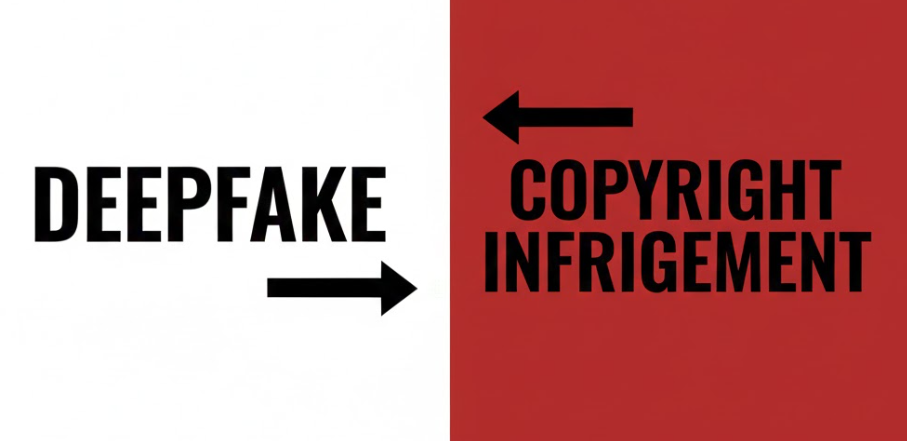
Deepfake technology has swept through the digital world, letting creators easily manipulate audio, video, and images. In August 2024, The New York Times dubbed a footage of Elon Musk as “The Internet Biggest Scammer” which led an 82-year-old retiree to invest USD 690,000 and drain all his retirement funds by being convinced that the video he has seen of Elon Musk was real. [5] Deepfake might be a legitimate art form, however they can also violate the rights of creators whose likenesses, voices, or works are used without their consent, it presents severe and potential copyright infringement challenges. The World Intellectual Property Organization (WIPO) in 2019 “Draft Issues Paper on Intellectual Property Policy and Artificial Intelligence” pointed out two main issues: Deepfakes frequently use copyrighted material, leading to essential ownership conflicts and do those whose likeness is exploited in deceptive content receive a fair share of the profits? [6]
Deepfake creations frequently violate ownership rights by using copyrighted material such as images, videos, and animations without the express consent of a copyright holder which constitutes a ground for infringement under Section 51 of the Copyright Act, 1957 which states that “Copyright in a work shall deemed to be infringed, when any person, without a licence, does anything, the exclusive right to do is conferred upon the owner of the copyright, or permits for profit any place to be used for the communication of the work to the public where such communication constitutes an infringement of the copyright in the work, unless he was not aware and had no reasonable ground for believing that such communication to the public would be an infringement of copyright; India does not have any legislation that deals with copyright infringement caused by deepfakes either explicitly or implicitly, Section 52 of the Copyright Act, 1957 provides an exhaustive list of fair dealingsacts which do not constitute copyright infringement and deepfake does not form part of the list which explicitly concludes that deepfake is a form of copyright infringement [7] Section 57 of the Copyright Act, 1957 protect author’s moral rights such as right to paternity & attributes i.e. to claim authorship of work, right to withdrawal, right against distortion and right to claim royalty for the work permitted to use, aligned with the moral rights specified in the Article 6 of the Berne Convention, 1886 which protects author’s work when it is used without their consent and the original work is changed [8].
Even though there is no law to regulate deepfakes in India, however, Section 66E and Section 66D of the Information Technology Act, 2000 penalises “a person who cheats by impersonating an individual or publishes or transmits images of a private area absent content in an electronic form” with imprisonment for up to 3 years or two lakh rupees fine. [9] In 2023, the Union government issued an advisory where Social Media Intermediaries such as Facebook, Twitter, Instagram has to recognize and to take reasonable due diligence against misinformation which violates rules and regulations and/or user agreements within the timelines as given under the IT Rules, 2021, they have to refrain from hosting deepfake content and in case if a content is reported then it must be taken down within 36 hours and failure to comply with the rules and the act will attract liability under Section 79 of the IT Act, 2000. [10] Fast forward in October 2025, The Ministry of Electronics and Information technology has prepared a draft rule for users to differentiate between genuine information and deepfake content and to hold social media platforms with over 50 lakh users accountable if the uploaded content is not authentic and is fabricated. [11].
Conclusion
The rapid growth of deepfake technology presents a complex challenge to Intellectual property rights and personality rights of a creator’s financial and ethical interests which are essential elements of copyright protection which ensures that authors retain control over their creations as well as acknowledged and compensated for their use. Big business platforms such as Meta, Google, Amazon supply the required tools and infrastructure to create deepfake content have a crucial ethical and moral obligation with a sense of responsibility to reduce the harm caused by such fabrication [12] India needs to tackle this issue with a stronger legislation, currently under Digital Personal Date Protection Act, (DPDP) 2023 ensures that any data intermediaries before taking any personal information must take reasonable steps to maintain privacy and breach of the same will result into penalty of up to 250 crores. [13] While the DPDP Act offers some protection, there is a need for a more specific and stronger law focused on deep-fakes and copyright infringement.