
Introduction
Most patents expire quietly. Novo Nordisk’s Indian patent on semaglutide, the molecule behind Ozempic and Wegovy, did not. It expired on 20 March 2026, and within 48 hours more than 15 Indian drugmakers had launched generic versions. Analysts expected 40 to 50 generics to enter the market, many priced 70 to 90 percent below the patented original. The episode raised two questions. How do Indian courts treat a patent that is close to expiry and has a vulnerable validity? And how does a brand name end up before a judge within days of a launch?
The patent battle: what the Delhi High Court decided
Novo’s Indian Patent 262697 (“IN’697”) covered semaglutide as a long-acting GLP-1 analogue. When Dr. Reddy’s Laboratories and OneSource Specialty Pharma began importing and exporting the drug in significant quantities, Novo issued a cease-and-desist notice. The defendants responded by starting revocation proceedings. They also told the Single Judge that they had already committed investments of over Rs 1,000 crore and had begun manufacturing. The Single Judge found that they had mounted a credible challenge to the patent’s validity. With less than seven months of the patent’s life left, and with Novo relying mainly on imports, the court refused an interim injunction. The defendants could continue to manufacture and export to markets where Novo held no patent, but they had to undertake not to sell in India. The Division Bench dismissed Novo’s appeal on 9 March 2026.
The patent law behind the ruling
Rights, term and remedies – Under Section 48 of the Patents Act, 1970, a patentee has the exclusive right to prevent others from making, using, selling, offering for sale or importing the patented product without consent. The right lasts for 20 years from the filing date under Section 53, and the term cannot be extended. Section 108 provides remedies such as an injunction and, at the plaintiff’s option, damages or an account of profits. That last remedy explains the Division Bench’s reasoning. When a patent is about to expire and irreparable harm is not shown, maintaining accounts of sales can protect the patentee, and an injunction granted late in the patent’s life would in practice decide the whole case. Interim relief also follows the usual three-part test of a prima facie case, balance of convenience and irreparable harm.
Validity is never presumed – Section 13(4) says that the Patent Office’s examination does not warrant a patent’s validity. A granted patent can therefore be attacked in three ways: pre-grant or post-grant opposition under Section 25, revocation under Section 64, or a counter-claim for revocation in an infringement suit. Under Section 64(1), revocation can be sought by a person interested or by the Central Government before the High Court, or by counter-claim in an infringement suit. Under the proviso to Section 104, an infringement suit with a revocation counter-claim is heard by the High Court, which is why the dispute was in Delhi.
The grounds of revocation – Three clauses of Section 64(1) mattered here. Clause (a) covers prior claiming, where the invention was already claimed in a valid claim of earlier priority in another Indian patent. Clause (e) covers lack of novelty, where the invention was publicly known, used or published before the priority date. Clause (f) covers obviousness or lack of inventive step in light of the same prior knowledge. For clauses (e) and (f), Section 64(2) says that personal documents, secret trials and secret use are not taken into account. The Single Judge found a credible case under clause (a). The Division Bench agreed with the conclusion but held that the correct grounds were prior publication under clause (e) and obviousness under clause (f).
Inventive step and the skilled person – An “invention” under Section 2(1)(j) is a new product or process involving an inventive step and capable of industrial application. Section 2(1)(ja) defines an inventive step as a technical advance over existing knowledge, or economic significance, or both, that makes the invention not obvious to a person skilled in the art. Obviousness is judged through this notional skilled person. In this case Novo held an earlier genus patent, IN’964, covering a broad class of GLP-1 analogues. One compound in it, Example 61 or Ala Semaglutide, differs from semaglutide by a single amino acid substitution at position 8 (alanine to Aib), and the genus patent itself directs a skilled person to make that substitution. The Court held that the step to semaglutide was one the prior art effectively pointed to, so the suit patent was prima facie vulnerable. The lesson is that a narrower follow-on patent can be undermined by the patentee’s own earlier filing.
Working of patents and imports – Section 83 states that patents are granted to encourage inventions to be worked in India on a commercial scale, and not merely to give the patentee a monopoly over imports. Section 84 allows compulsory licences where the public’s reasonable requirements are not met, the invention is not available at a reasonably affordable price, or it is not worked in India. The Controller granted India’s first compulsory licence in 2012 to Natco in the Bayer Nexavar case. These provisions were not the basis of the ruling, but they explain why Novo’s reliance on imports was relevant to how the Court weighed harm and public interest.
Restraint on appeal – The Division Bench applied the Supreme Court’s decision in Wander Ltd. v. Antox India and the more recent Pernod Ricard v. Karanveer Singh Chhabra (2025). An appellate court does not interfere with a discretionary interim order unless it is arbitrary, perverse or contrary to settled principles. The findings on validity are prima facie, and the final decision will come in the revocation proceedings.
Aftermath – The compound patent’s expiry did not end Novo’s patent fight. It filed suits over a separate patent on its oral tablet formulation, which claims a particular range of an absorption enhancer. Generics argue that their tablets fall outside that range, and those claims remain untested. On the day the injectable patent expired, the Delhi High Court recorded an interim agreement between Novo and Torrent Pharma. Prices fell quickly: from roughly Rs 10,000 per month in 2022 and Rs 17,345 to Rs 26,015 for injectable weight-loss formulations in 2025, to sharply lower levels after expiry.
The naming trap: from Olymviq to Olymra
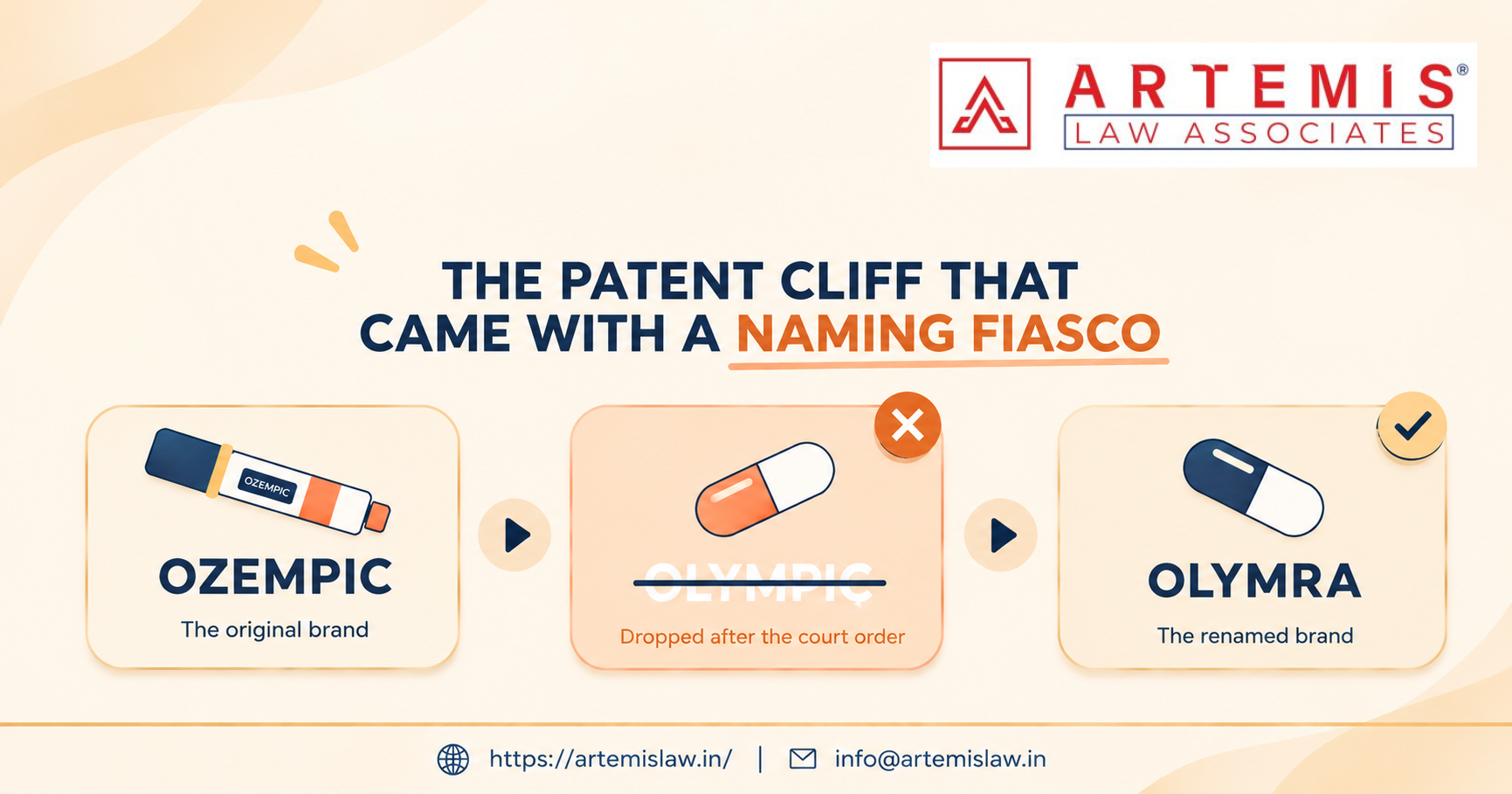
With the patent fight largely over, a second dispute began over branding. Dr. Reddy’s launched its generic on 21 March under the name Obeda, and it also used a second brand name, Olymviq. Novo sued for trademark infringement, arguing that Olymviq was phonetically and visually similar to Ozempic, a coined mark in use since 2014 across more than 100 countries. Pharmaceutical marks face a stricter test. Courts have followed the Supreme Court’s Cadila ruling, and a 2023 Bombay High Court decision repeated that even a slight chance of confusion between medicines is enough to restrict a similar mark. A 2022 Delhi High Court case on Letroz and Letero shows the other side, because both names came from the same generic name and the court found no deceptive similarity. The Delhi High Court directed Dr. Reddy’s to stop selling under Olymviq, observing that the name was prima facie phonetically similar to Ozempic.
On 27 March, Dr. Reddy’s told the court it would rename the product Olymra, and Novo agreed in principle. The company agreed to stop all manufacture, sale, supply, export and promotion under Olymviq, withdraw its four pending applications for the mark, and avoid any mark deceptively similar to Ozempic in the future. Existing stock could be sold within 30 days, with unsold inventory donated to a government hospital, and Novo received 30 percent of its claimed costs.
Conclusion
The semaglutide story shows that a patent is a time-limited bargain with no presumption of validity. Interim relief late in a patent’s life is an uphill battle, a validity challenge based on the patentee’s own earlier patent can succeed at the interim stage, and follow-on patents invite scrutiny under the doctrines of inventive step and evergreening. Once a compound patent expires, the contest moves to formulation patents and to brands, where a name that sounds too close to a famous mark can bring a quick injunction. For innovators, the lesson is to enforce early, draft layered patents carefully and protect the brand beyond the patent’s life. For generic manufacturers, it is to build a credible validity challenge early and to clear the brand name as carefully as the chemistry.